
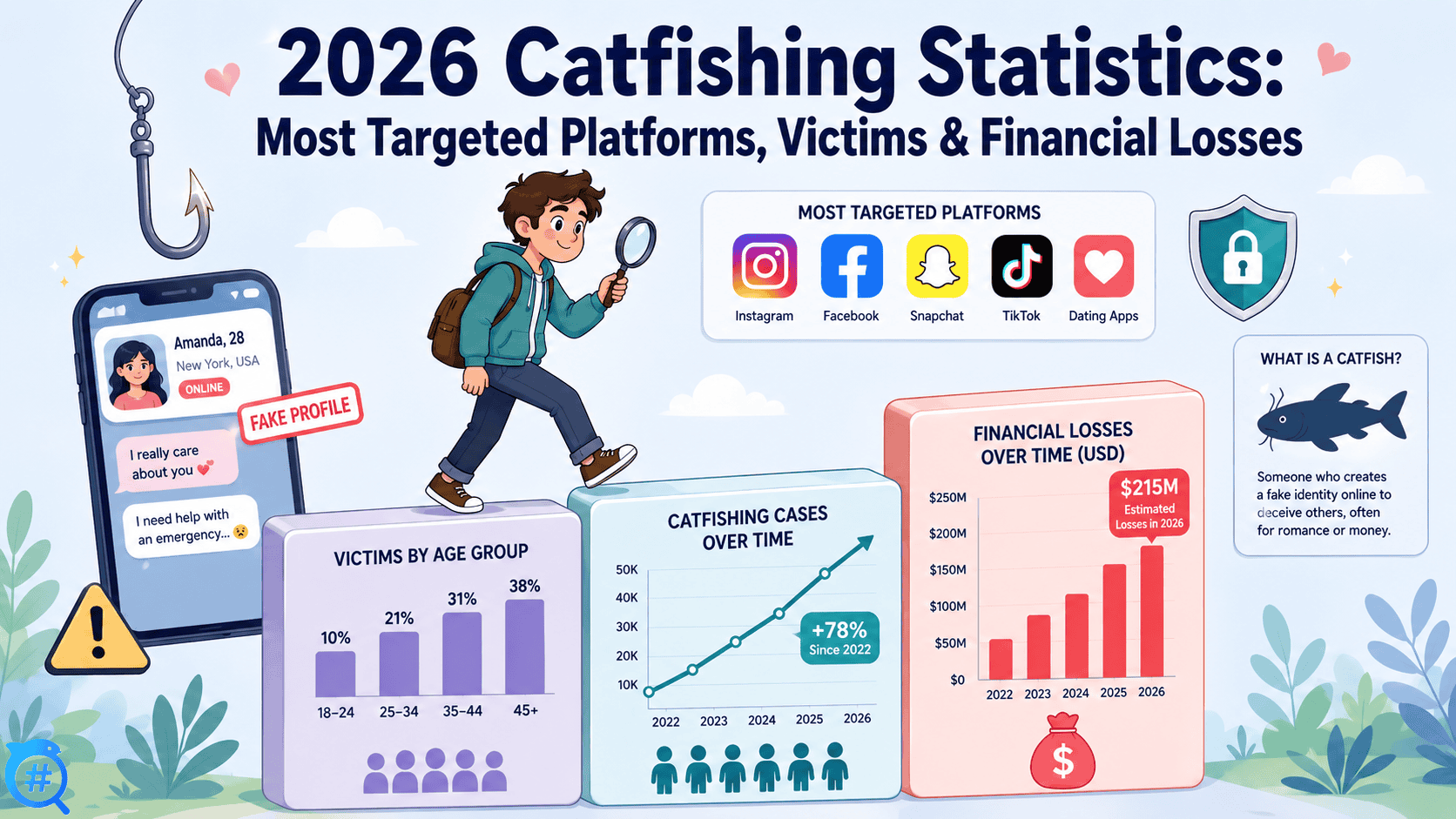
Before, catfishing meant a middle-aged man pretending to be a teenage girl, and now it has evolved into a system that’s far more calculated and harder to spot.
Catfishes pull people in, build trust, and then damage victims’ trust, privacy, emotional stability, and sometimes, years of savings.
So who gets targeted? Is it random exposure, or something more predictable hiding in plain sight? Could you be the next victim without even realizing it?
I looked into the statistics and patterns – here’s what stands out:
TL;DR
🌍 Most catfishing cases go unreported. In the U.S., only 5% of victims come forward, meaning real victims likely exceed 1.4 million per year.
💬 Social media drives most scams, with about 60% of romance scams starting there.
🤖 AI has made catfishing harder to detect. Fake profiles can now create fake faces, voices, and deepfake videos in under 5 minutes.
🎣 Catfishing affects all groups, but seniors lose the most financially – individuals aged 60+ lost $7.7B in 2025, despite fewer reports.
💔 The damage extends beyond money. Victims report 69% stress, 17% long-term confidence loss, 97% behavior change, and 14% isolation.
How Many People Get Catfished a Year?
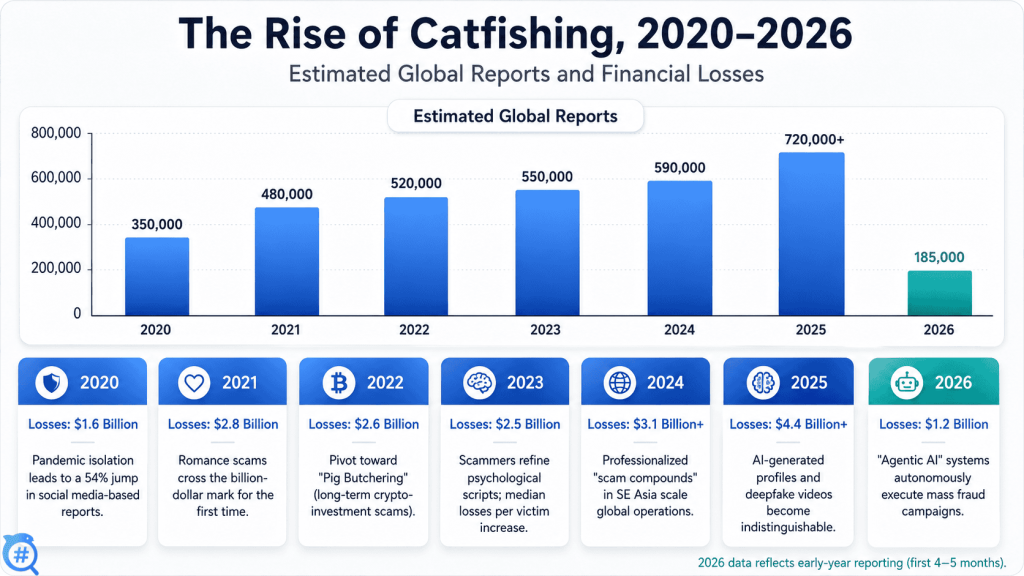
Global research from GASA places yearly catfishing-related reports between 500,000 and 750,000 worldwide from 2020 to 2026.
That number surged past 720,000 in 2025, according to reports from Nasdaq Verafin and TRM Labs, alongside more than $4.4B in losses.
FTC reports suggest 2026 is moving just as fast, with around 185,000 cases and $1.2B in losses already recorded in the first few months alone.
In the U.S., roughly 70,000 cases are filed yearly, yet GASA research suggests only 1 in 20 victims ever come forward, putting the real number above 1.4 million victims annually.
The data barely scratches the surface.
CatfishNumber’s analysis suggests that as long as people seek connections online, scammers will keep building systems designed to exploit it.
| Year | Est. Global Reports | Est. Global Financial Losses | Primary Trends & Shift in Tactics |
| 2020 | 350,000 | $1.6 Billion | Pandemic leads to a 54% jump in social media-based reports |
| 2021 | 480,000 | $2.8 Billion | Romance scams cross the billion-dollar mark |
| 2022 | 520,000 | $2.6 Billion | Shift to “pig butchering” crypto scams |
| 2023 | 550,000 | $2.5 Billion | Improved emotional manipulation; losses per victim rise |
| 2024 | 590,000 | $3.1 Billion+ | Organized scam centers in Southeast Asia expand globally |
| 2025 | 720,000+ | $4.4 Billion+ | AI profiles and deepfakes become hard to tell apart |
| 2026 | 185,000 | $1.2 Billion | AI systems now run large-scale scams on their own |
What Platforms Does Catfishing Start On Most?
According to CatfishNumber’s findings, catfishing begins on platforms where people overshare, comment, post, scroll, flirt, vent, or reply.
Basically, anywhere there are active users, data, and interaction, there’s material that catfishes could use against you.
- Facebook and Instagram remain the top starting points for the 60% of romance scams initiated on social media.
- About 38% of Snapchat users aged 13–24 reported being targeted by sextortion schemes.
- TikTok sees an estimated 8 million scam incidents per year tied to fake engagement, bots, and viral bait content.
- Social media scam losses reached $2.1 billion in 2025 (up 8x since 2020).
As for dating apps, they remain prime territory for catfishing because they have millions of people actively looking for connection.
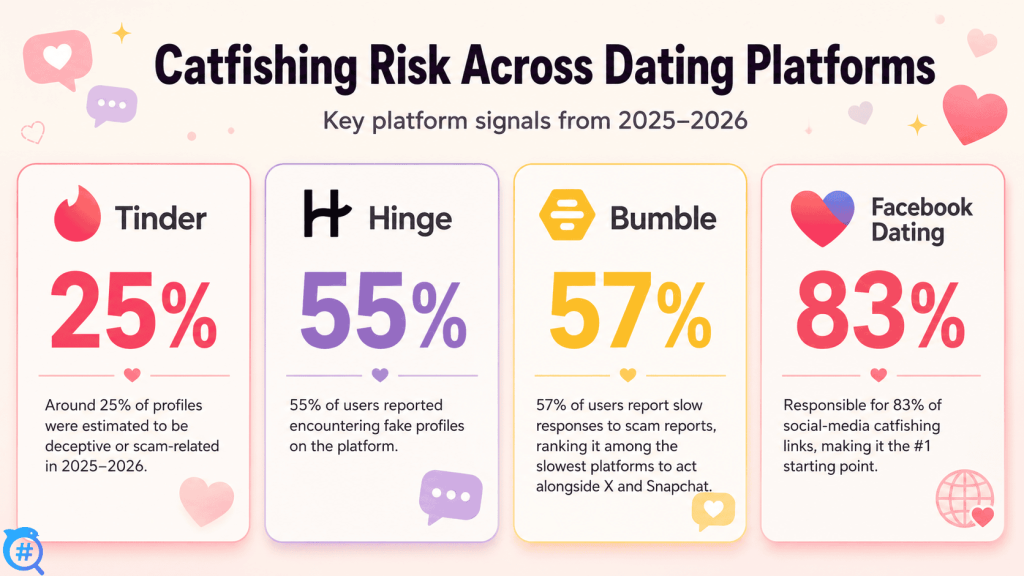
| Platform | Catfishing patterns |
| Tinder | 25% of profiles are estimated to be deceptive or scam-related |
| Hinge | 55% of users reported fake profiles |
| Bumble | 57% of users reported slow scam-report responses |
| Facebook Dating | Responsible for 83% of social-media catfishing links |
➡️ By 2026, fake profiles had become common across Tinder, Hinge, Bumble, and Facebook Dating.
Over 55% of users say they’ve run into profiles they were convinced weren’t real or were intentionally misleading during the last year.
Roughly 1 in 4 (25%) dating profiles may contain significant lies: a fake job or a stolen identity. Once trust is built, catfishes move the chat to a private app.
The average reported loss from dating-related catfishing scams reached roughly $2,500 in 2025. 💸
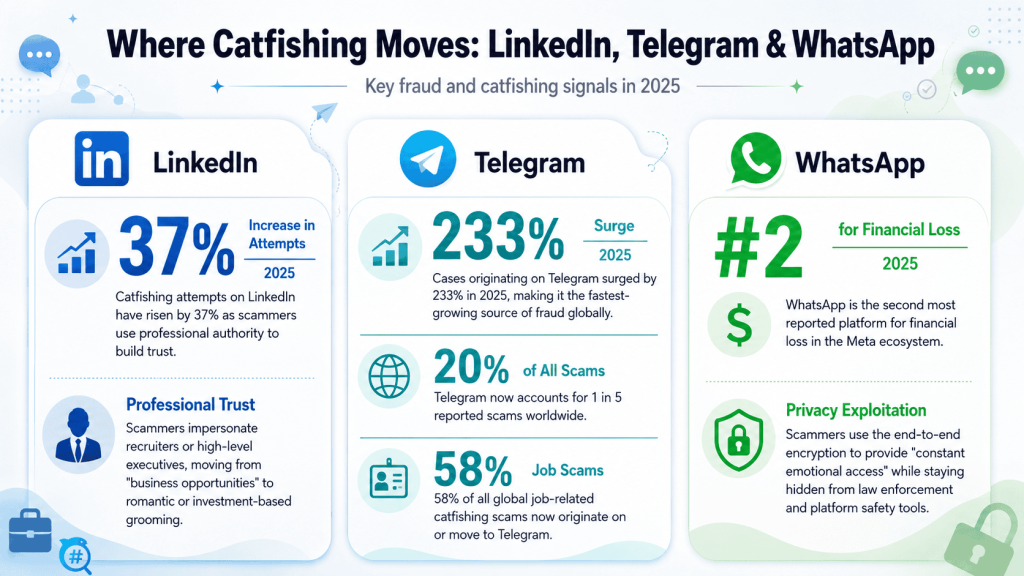
LinkedIn scam activity rose 37% in 2025 through fake recruiters and executives.
Telegram scams surged 233% in 2025, including 58% of job-related scams, and now represent 20% of global scam reports.
WhatsApp remains a major fraud channel because encrypted chats reduce moderation and safety checks.
Who’s Targeted the Most by Catfishes in 2026?
The facts show that catfishing is not limited to one age group, gender, or platform anymore. Different groups are targeted in different ways:
| Category | Statistic | Context |
| Ages 30–49 | 42% of reports | Most commonly reported victims. |
| Ages 60+ | $7.7 B lost | Fewer reports (22%); the median loss is $9,000, so 4x higher than younger groups |
| Gen Z | 18% of reports | Mostly targeted through TikTok, Snapchat, and sextortion scams |
| Men | 55.5% of reports | Men reported more catfishing cases in 2025 |
| Women | 62% of financial losses | More likely to be pulled into long-term emotional and investment scams |
| Professionals | 70% college-educated | High earners are targeted through LinkedIn impersonation scams |
| LGBTQ+ Users | 2.5x higher risk | Higher exposure to fake identities in dating spaces |
Scammers often target people going through major life changes, such as divorce, grief, or retirement, because trust is built faster during unstable moments.
Also, people who reply to strangers, move chats off-platform quickly, or feel emotionally open are easier to reach. And since many victims never report it, the cycle keeps repeating quietly.
🔎 Did you know?
A survey by GASA and Feedzai found that out of 46,000 adults in 42 countries, 57% were exposed to a scam in the past year, with 13% encountering one daily.
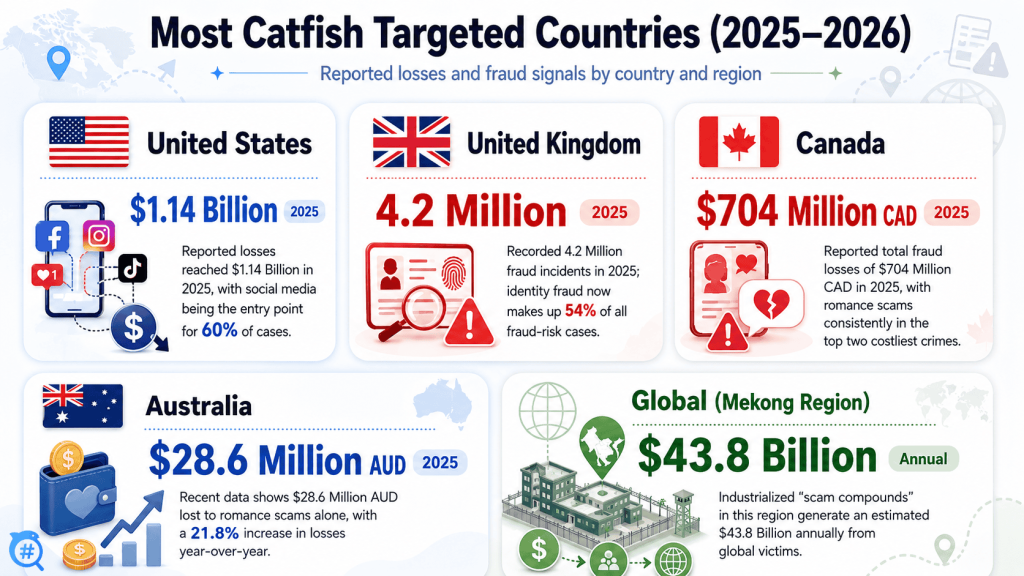
Looking at countries, reported losses in 2025–2026 are highest in the U.S., UK, Canada, and Australia, ranging from hundreds of millions to over $1.1B.
At the same time, large scam operations in regions like the Mekong area generate tens of billions globally.
The Rise of Deepfakes and AI Catfishing
For years, video calls were the best way to verify someone’s identity, but in 2026, that’s no longer reliable.
With AI, catfishes can now build a full identity from scratch in seconds (face, voice, and personality), making fake people easier to believe.
Deepfakes can now survive full conversations without obvious glitches. And as the technology gets cheaper and more accessible, it’s only going downhill…
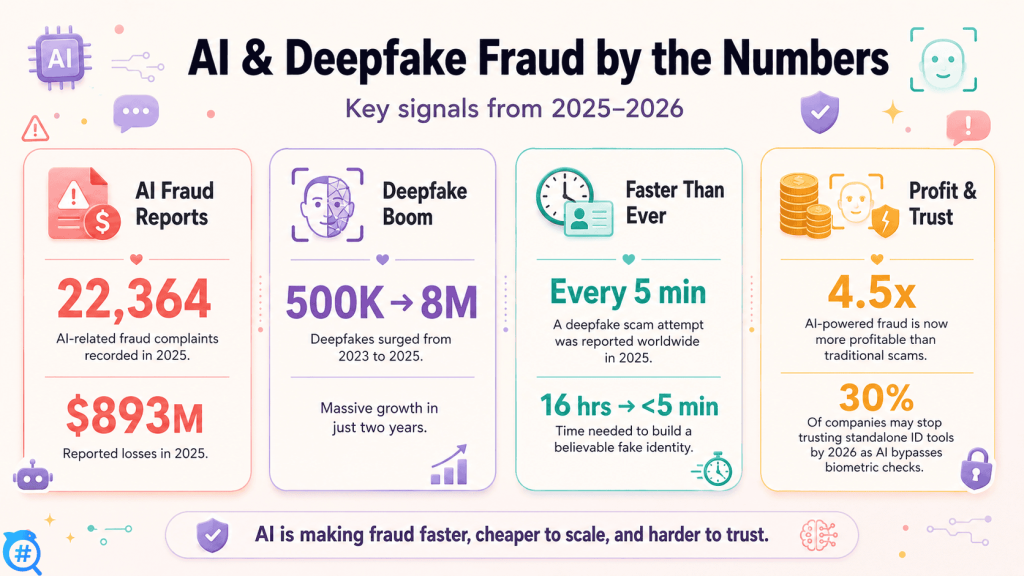
- In 2025, 22,364 AI-related fraud complaints were recorded, totaling nearly $893 million in losses.
- Between 2023 and 2025, the number of deepfakes grew from 500,000 to 8 million.
- Deepfake scam attempts were reported every 5 minutes worldwide in 2025.
- AI cut the time needed to build a believable fake ID from 16 hours to under 5 minutes.
- AI-powered fraud is now 4.5x more profitable than traditional scams.
- By 2026, about 30% of companies are expected to stop trusting standalone identity-verification tools because AI can easily bypass biometric checks.
CatfishNumber’s Tip: If something feels off, test unpredictability. Ask for something random and unscripted: a candid photo, a live video, or anything that breaks a rehearsed flow.
The Damage After Getting Catfished
Catfishing is designed to wear people down slowly. By the time victims realize what happened, the damage usually goes far beyond money.
- Average scam duration before money requests: 7 months
- Some AI impersonation scams lasted over a year
- 21% of victims say they felt pressured to constantly maintain the relationship
While money can sometimes be recovered, the mental health fallout often persists long after the bank account is empty.
| 69% of victims report severe stress following the scam. |
| 17% of victims lose confidence long-term. |
| 97% of victims change how they pay or share info online forever. |
| 14% report family tensions or total isolation from loved ones. |
By the end of 2025, the FBI had referred 80 victims to emergency suicide intervention (almost double the 42 cases reported in 2024), and about77% of them had no idea they were being scammed until agents stepped in.
Not a very fun fact: Digital scams now generate between $442 billion and $1 trillion every year globally, based on INTERPOL’s fraud tracking and UN analyses of the scam economy.
So, What Are the Odds of Getting Catfished?
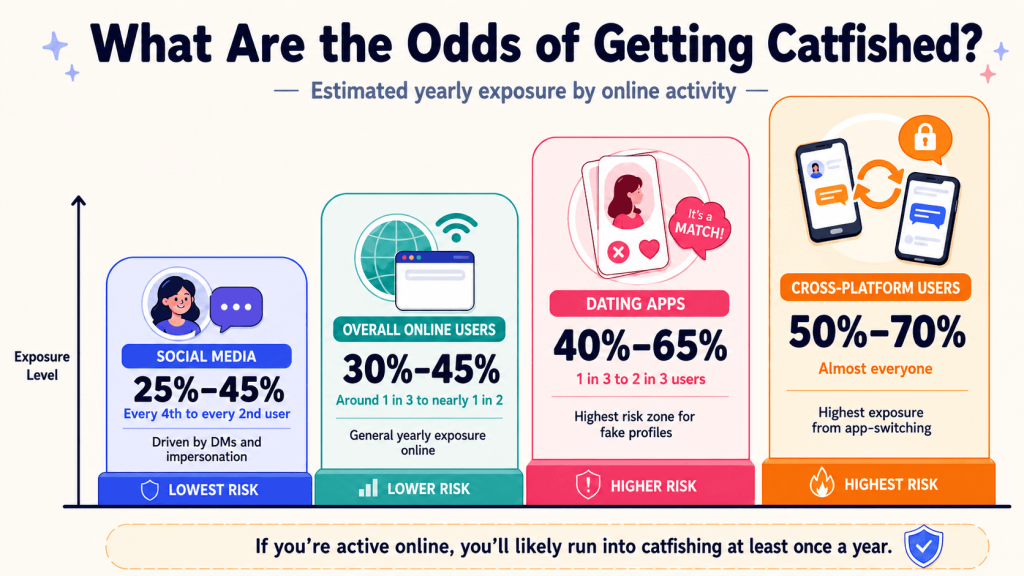
Based on CatfishNumber’s statistics of platform data, user reports, and behavior patterns, catfishing is more about how often it shows up on specific platforms and how users interact with it.
Here’s what the yearly exposure looks like across different platforms:
- Overall online users: 30% – 45%
- Social media: 25% – 45%
- Dating apps: 40% – 65%
- Cross-platform users: 50% – 70% (almost everyone)
In plain terms: if you’re active online, you’re likely to run into it at least once in a given year, even if it never turns into a full-blown scam.
However, this is only an approximate estimate – it doesn’t mean that catfishing can’t happen more or less often.
Sources:
- 1 2024 IC3 ANNUAL REPORT
- 1 2025 IC3 ANNUAL REPORT
- New FTC Data Show People Have Lost Billions to Social Media Scams
- Vyntra 2026 Fraud Report: AI-Driven Scams Drive $442B in Global Losses
- Fraud Prevention Month to bring hidden crime into the spotlight
- Catfishing Statistics: Market Data Report 2026
- Let’s aim for more happily-ever-afters, fewer scams, in 2026 | Northern Territory Consumer Affairs
- Social media scam-related losses surge, FTC report finds | brief
- UK Romance Fraud Losses Reach £106 Million as New Independent Report Maps Scale of Dating App Safety Challenge
- INTERPOL report warns of increasingly sophisticated global financial fraud threat
- Consumers Lose Billions to Social Media Scams, FTC Finds – ACA International
- Countering Digital Scams
- Global Scams on the Rise: Over Half of Adults Worldwide Report Scam Encounters, 23% lost money
- Global Anti-Scam Alliance Policy Agenda 2026
- 2026 Data Spotlight: Social Media Scams
- Global Financial Crime Report 2026
- 2026 Global Financial Fraud Threat Assessment
- 2026 Romance Scam Report
- Social Media Catfishing: Statistics, Facts and Trends Guide for 2026
- Telegram Named Fastest-Growing Source of Fraud in 2025
- SENTINEL-FRAUD: U.S. Consumer Scam Threat Assessment
- New FTC Data Show People Have Lost Billions to Social Media Scams Deepfake Statistics & Trends 2026 | Key Data & Insights – Keepnet
- Cryptocurrency and AI Scams Bilk Americans of Billions — FBI
- Deepfakes leveled up in 2025: Here’s what’s coming next – University at Buffalo
- Deepfake Attempts Occur Every Five Minutes Amid 244% Surge in Digital Document Forgeries | Entrust
- What is catfishing? How to spot and avoid it
- FBI: Crypto, AI Scams Drove Billions in Losses in 2025
- Stay Safe from AI Scams in 2026 | IN, MI Everwise Credit Union
- Global Scams on the Rise: Over Half of Adults Worldwide Report Scam Encounters, 23% lost money
- https://www.lseg.com/content/dam/risk-intelligence/en_us/documents/gated/white-papers/lseg-risk-intelligence-white-paper-global-fraud-report-2026.pdf
- AI has raised the stakes in romance scams, and consumers want action
- Operation Level Up — FBI
Leave a Reply